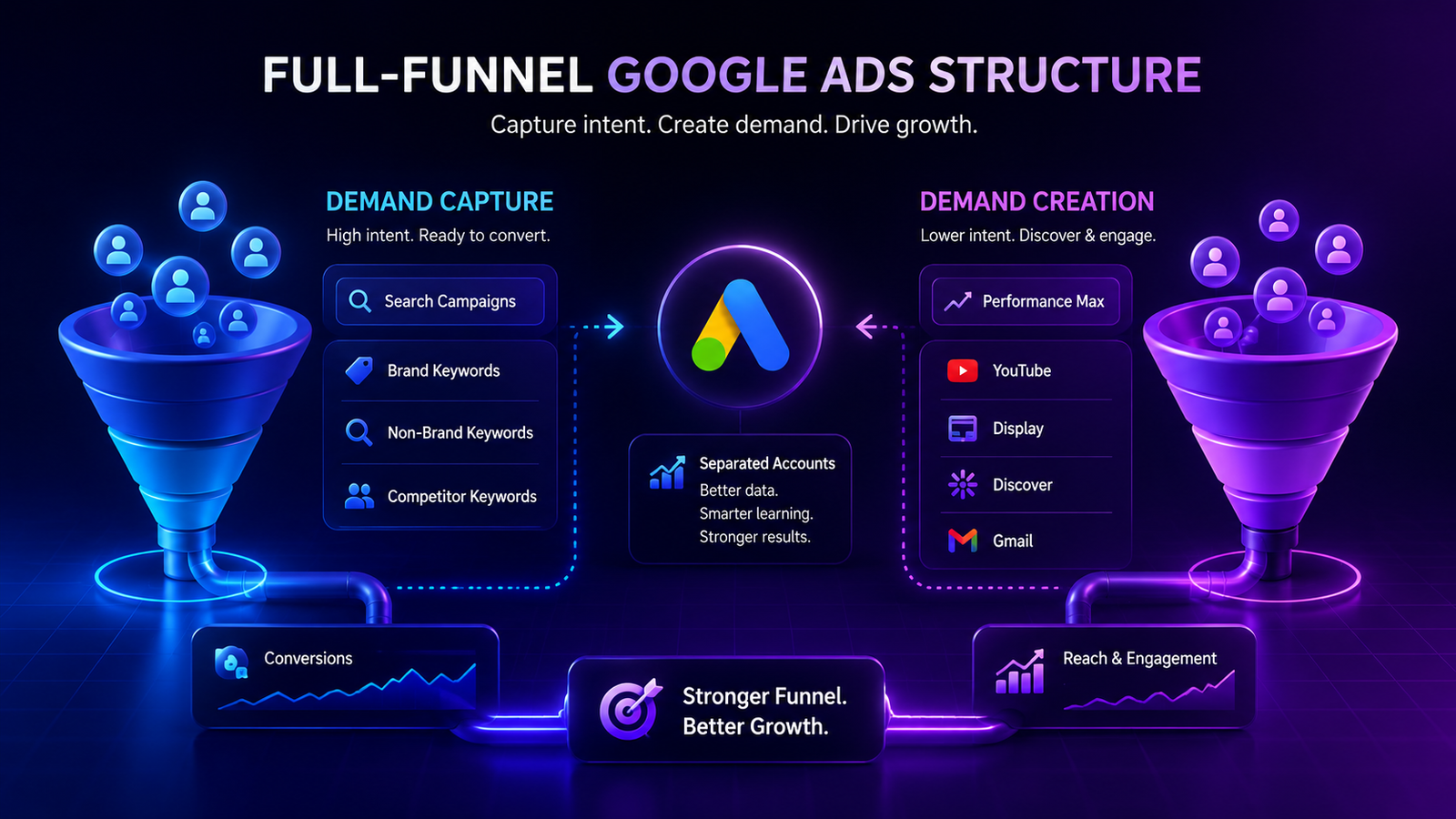
Many Google Ads accounts become difficult to scale because too many campaign types are blended together without clear separation. Brand campaigns, generic search, competitor targeting, remarketing, and automated campaigns often compete against each other for the same conversions, making performance analysis unreliable.
A strong account structure creates cleaner signals for both advertisers and the algorithm. When campaigns have clearly defined roles, it becomes easier to identify what is driving incremental growth, where budget should expand, and which parts of the funnel require improvement.
The goal of a full-funnel structure is not complexity for its own sake. It is clarity. Clean segmentation allows campaigns to learn faster without stepping on each other’s data or confusing attribution signals.
The starting campaign map
The first version of an account should usually separate campaigns by intent level rather than simply by keyword volume. Different search behaviors represent different stages of buyer readiness and should be treated accordingly.
- Brand search protects demand you already created.
- Generic search captures active category demand.
- Competitor search tests switching intent carefully.
- Retargeting supports delayed decision-making.
- Performance Max scales only after feeds, assets, and exclusions are clean.
This structure makes reporting easier because each campaign category serves a specific purpose inside the acquisition funnel instead of overlapping unpredictably.
Prevent cannibalization early
One of the most common scaling issues in Google Ads is campaign cannibalization. Automated campaigns often begin claiming conversions that would have happened through branded search, remarketing, or direct traffic anyway.
Strong account structures reduce this problem through proper exclusions, audience segmentation, landing page grouping, and conversion prioritization. The objective is to understand which campaigns are actually generating incremental business value.
Attribution becomes far more useful when campaigns are isolated by role and intent rather than blended into a single reporting layer.
Google’s automation systems are powerful, but they still depend on structured data, clear conversion signals, and logical campaign organization. Accounts without structure often scale inefficiently because the algorithm receives mixed signals.
Review by role
Campaign performance should always be judged based on the job each campaign is supposed to perform. Brand campaigns are designed for efficiency and protection. Generic campaigns uncover scalable intent. Retargeting supports conversion recovery. Competitor campaigns test switching behavior carefully.
When all campaigns are evaluated using identical efficiency targets, optimization decisions become distorted. Some campaigns are designed to generate demand, while others are designed to capture it.
The strongest Google Ads accounts are usually not the most complicated. They are the clearest, most organized, and easiest to interpret during scaling decisions.