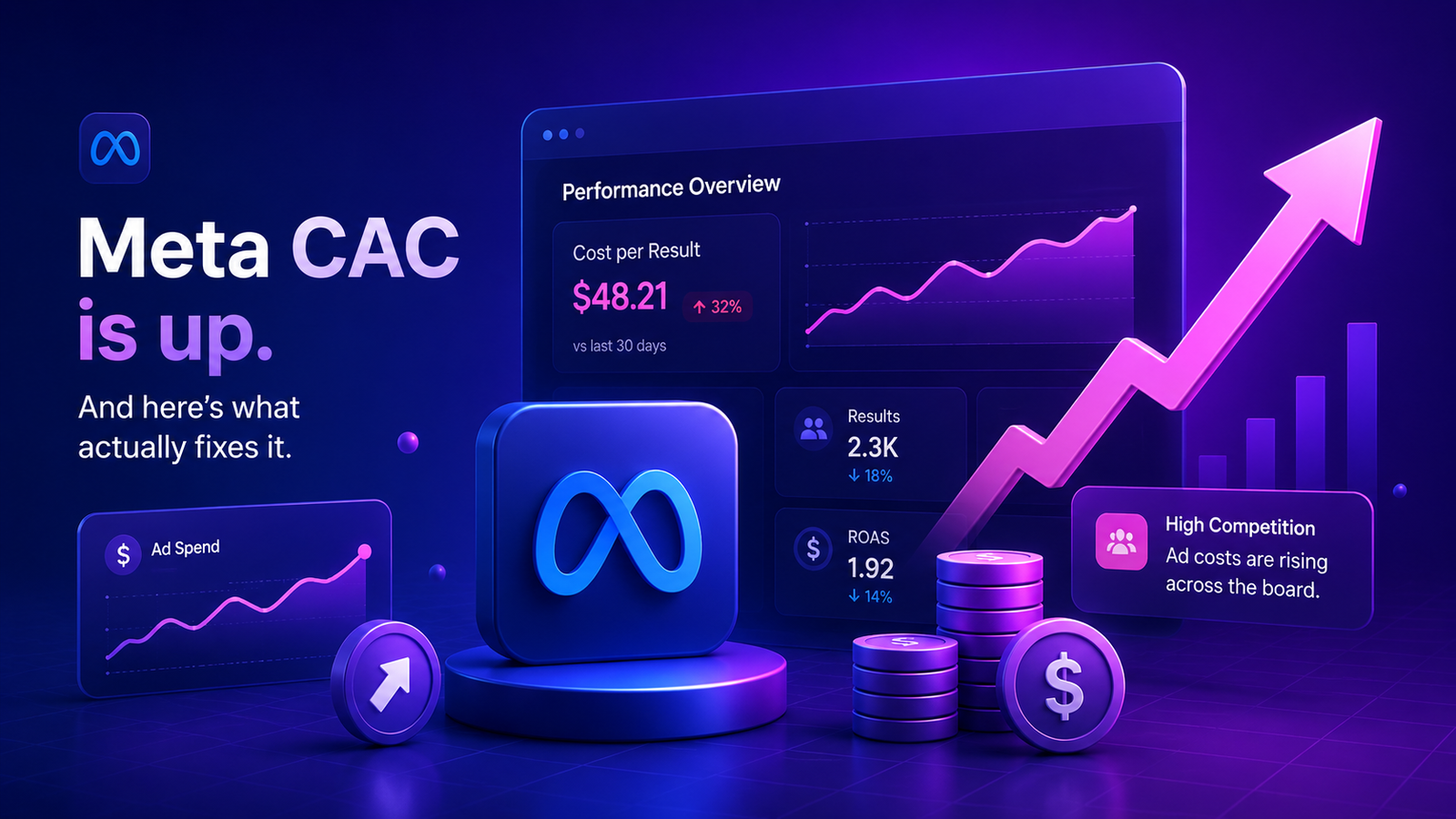
Rising CAC is rarely caused by a single issue. In most Meta ad accounts, acquisition costs increase because creative systems stop generating strong engagement signals. When the same angles, visuals, and messaging are shown repeatedly to the same audience, performance naturally declines as attention drops and frequency increases.
Meta rewards advertisers that continuously feed the platform fresh creative signals. If the audience is broad but the creative set is narrow, fatigue arrives quickly. On the other hand, if the creative library is large but the offer lacks clarity, spend becomes scattered without generating meaningful learning.
The problem is often not targeting itself — it is the relationship between audience breadth, creative diversity, landing page clarity, and conversion intent. Accounts that scale efficiently usually operate like testing engines rather than static campaign structures.
The ratio that matters
For each major audience or campaign theme, maintain enough creative angles to test different buyer motivations consistently. Healthy accounts separate performance learning from budget scaling so that campaigns continue improving instead of exhausting the same assets repeatedly.
A strong creative mix usually includes problem-led hooks, proof-led assets, founder-led messaging, customer objections, product demonstrations, comparisons, and clear outcome-focused positioning. Different users respond to different emotional triggers, and Meta’s system needs variety to identify what performs best.
- Refresh winning creatives before they fully fatigue.
- Separate creative testing from scale campaigns.
- Judge hooks, formats, and offers independently.
- Test different audience motivations instead of only new visuals.
- Track engagement quality, not just CTR.
Most brands scale longer when they treat creative production as an ongoing operating system instead of a one-time campaign task. The accounts with stable CAC are usually shipping new concepts every week, even when current ads are still performing.
Fix the offer before blaming the algorithm
Strong offers create clearer conversion signals because the right audience responds faster and with more conviction. Weak offers make every audience look expensive because Meta struggles to identify who is most likely to convert.
If landing pages feel generic, pricing is unclear, positioning lacks differentiation, or the value proposition is weak, acquisition costs increase regardless of targeting quality. The platform can amplify demand, but it cannot manufacture product-market fit.
In many cases, improving the clarity of the promise, reducing friction on the landing page, or sharpening the offer can lower CAC faster than launching entirely new campaign structures.
What to do this week
Instead of rebuilding the entire account immediately, focus on diagnosing where the actual breakdown is happening. Small structural improvements often outperform dramatic campaign resets.
- Group current ads by angle, not format.
- Pause duplicated messages competing for the same audience.
- Launch five new creative angles before increasing budget.
- Review landing page clarity and conversion friction.
- Measure creative fatigue weekly instead of monthly.
Meta performance improves when the account continuously generates new learning signals. Brands that scale sustainably usually win through creative iteration speed, offer clarity, and disciplined testing systems — not secret targeting tricks.