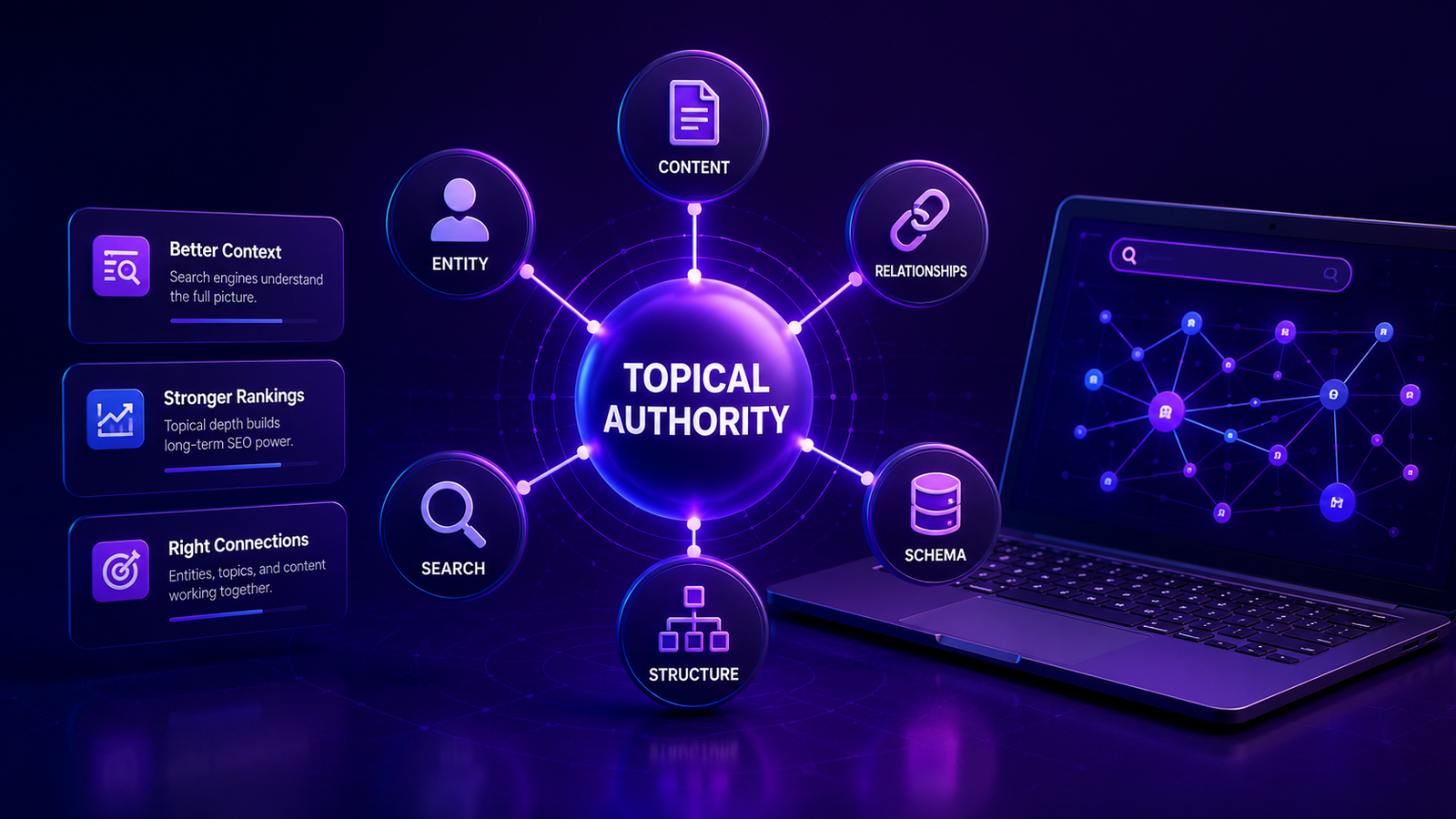
Topical authority is still one of the strongest signals in SEO, but many websites misunderstand how it actually works. Publishing dozens of loosely related articles does not automatically create authority. Search engines increasingly evaluate how well a website explains relationships between concepts, entities, and user intents across an entire topic ecosystem.
Modern SEO is less about keyword stuffing and more about helping search engines understand context. Strong content systems make it easy for both users and algorithms to navigate from broad concepts to detailed implementation, comparisons, use cases, and decision-stage information.
Classic pillar-and-cluster planning often creates organized spreadsheets but weak user experiences. Entity-first planning focuses on the real concepts, workflows, tools, integrations, problems, and alternatives buyers actually connect together while researching solutions.
Map the knowledge graph
Instead of starting with isolated keywords, begin by identifying the major entities surrounding the category. These can include tools, roles, industries, pain points, integrations, workflows, competitors, and implementation challenges.
Once the core entities are identified, define how they relate to each other. Strong topical authority comes from clearly explaining prerequisites, comparisons, use cases, alternatives, constraints, and supporting concepts across the site.
When content mirrors the way real buyers explore information, search engines gain stronger signals about expertise and subject depth.
Build pages that clarify relationships
Many websites create content that exists in isolation. Stronger content ecosystems help users understand how ideas connect together across the entire buying journey.
- Explain when one approach is better than another.
- Connect use cases to product capabilities.
- Use internal links to reinforce real conceptual paths.
- Create comparison and implementation content around core topics.
- Support educational pages with commercial relevance.
Internal linking should not only improve crawlability — it should improve understanding. The goal is to help users move naturally between related concepts without friction or confusion.
Search engines increasingly reward websites that behave like organized knowledge systems rather than disconnected article collections. Clarity, structure, and contextual depth matter more than publishing volume alone.
Refresh by coverage gaps
Content updates should focus on missing relationships and unanswered buyer questions instead of only refreshing publish dates. Many libraries already contain valuable content but fail because critical supporting pages are absent.
Review your existing content and identify where buyers still lack comparisons, implementation guidance, proof, definitions, or decision-stage information. Often, a few strategically connected pages can strengthen the performance of an entire topic cluster.
Topical authority is not built by creating more content randomly. It is built by systematically reducing confusion and increasing contextual understanding across the entire site.