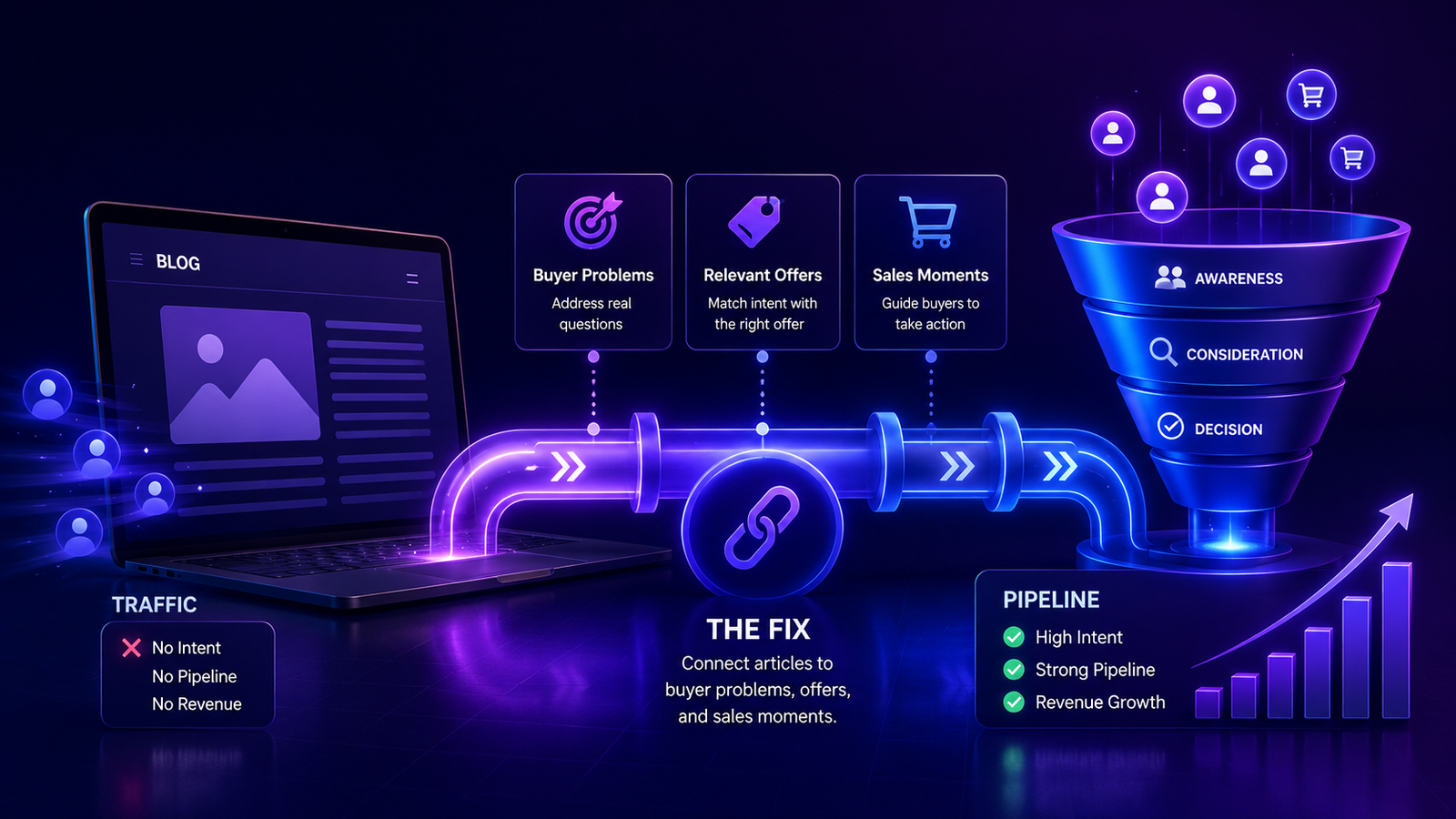
Many blogs successfully generate traffic but still fail to create meaningful business impact. The issue is usually not content quality alone — it is the absence of commercial alignment. Articles attract visitors, but they do not guide readers toward a buying decision, deeper engagement, or any logical next step.
Traffic without commercial intent becomes an expensive vanity metric when content programs are measured only by impressions, rankings, or pageviews. Stronger content strategies focus on how articles contribute to trust, qualification, product understanding, and pipeline generation over time.
High-traffic posts often underperform because they answer broad informational questions for audiences that are not yet close to making a decision. That does not make these articles useless, but it changes their purpose inside the funnel.
The five-question test
Before publishing or updating any article, evaluate whether the content has a clear business role beyond attracting search traffic. Strong content systems intentionally connect educational value to commercial relevance.
- Who is the buyer behind this query?
- What business problem are they trying to solve?
- What should they do after reading?
- Which internal page should this article support?
- How will sales use the insight from this page?
If an article cannot answer these questions clearly, it may generate visibility without creating measurable business value. The goal is not simply to attract visitors — it is to move the right audience deeper into the decision journey.
Match CTAs to intent
Not every visitor is ready for a demo request or sales call. Different stages of awareness require different calls-to-action that match the reader’s current level of intent and trust.
Early-stage readers may respond better to templates, diagnostic tools, newsletters, comparison pages, or educational resources. High-intent visitors may prefer consultations, pricing pages, audits, or implementation-focused offers.
The biggest mistake many blogs make is forcing every visitor toward the same CTA regardless of intent level. Stronger content systems create multiple conversion paths that feel natural within the context of the article.
Even articles that do not convert directly can still strengthen authority, support retargeting, improve internal linking, or build familiarity with the brand before future buying moments occur.
When to kill a post
Not every article deserves to remain in the content library permanently. Some pages attract low-quality traffic, dilute topical focus, or fail to support any meaningful business objective.
If a page has weak commercial relevance, poor engagement, no conversion pathway, limited authority value, and no strategic positioning role, it may be better to merge, redirect, or remove it entirely.
Strong content programs grow through refinement, not just expansion. The highest-performing blogs are usually curated systems where every article supports a broader strategy instead of existing only for search volume.